Discover how Google AI Search in 2026 is transforming SEO and digital marketing. Learn about AI Overviews, personalized search, and strategies to stay ahead.
Searching on Google is no longer just about typing a few keywords and scrolling through a list of blue links. In 2026, Google Search has evolved into an AI-powered experience that understands context, answers complex questions, and delivers more personalized results than ever before.
With the introduction of AI Overviews, AI Mode, and deeper integration of Google's Gemini AI, users can now have conversational interactions with Search, ask follow-up questions, and receive tailored recommendations based on their interests and preferences.
For businesses, marketers, and website owners, this isn't just another algorithm update, it's one of the biggest transformations in the history of Google Search. Companies that adapt to AI-powered search will have a significant advantage, while those relying on outdated SEO strategies may struggle to maintain visibility.
In this blog, we'll explain Google's latest AI Search experience, how personalized search is changing user behavior, what it means for SEO and digital marketing, and how businesses can prepare for the future of search.
What Is Google's AI Search Experience?
Google's AI Search experience combines traditional search results with advanced artificial intelligence to help users find answers faster and more naturally.
Instead of simply displaying a list of websites, Google can now understand the intent behind a question, summarize information from multiple trusted sources, and present an AI-generated response before showing relevant web pages.
For example, instead of searching:
"Best SEO strategy"
Users are increasingly asking:
"What's the best SEO strategy for a local business that wants more leads without increasing advertising costs?"
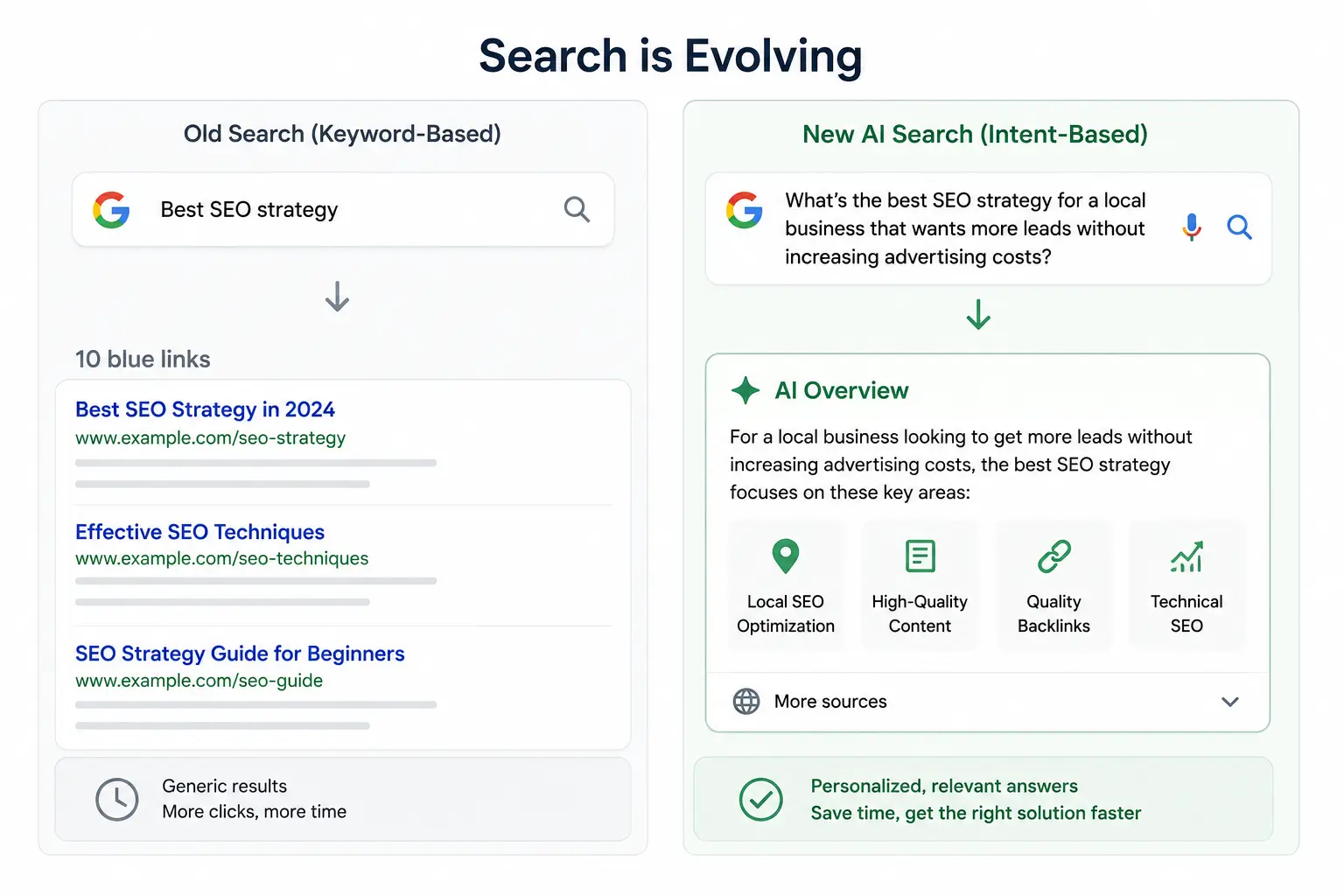
Google's AI can understand this complete question and provide a comprehensive answer while still linking to relevant websites for deeper information.
Some of the major AI-powered features include:
- AI Overviews that summarize information directly within Search
- AI Mode for conversational and follow-up searches
- Gemini-powered reasoning for complex questions
- Voice, image, and multimodal search experiences
- More personalized search recommendations
This makes Google Search feel more like having a conversation with an intelligent assistant rather than using a traditional search engine.
Understanding Personalized AI Search
One of the most significant developments in Google Search is personalization.
When users choose to enable personalization features, Google can use information such as:
- Previous searches
- Search preferences
- Location
- Language
- Interests
- Travel plans
- Calendar events
- Gmail information (with user permission)
This allows Search to provide answers that are more relevant to each individual.
Example
Imagine two people searching for: "Best coffee shop."
- A traveler visiting Mumbai may receive recommendations near their hotel.
- A remote worker searching from Noida may receive cafes with Wi-Fi and work-friendly environments.
- Someone who frequently searches for vegan food may see completely different recommendations.
Rather than showing identical results to everyone, Google aims to deliver search experiences that match each user's unique context.
Users also have full control over their personalization preferences through Google Search Help, where they can manage search history, privacy settings, and AI personalization options.
What's New in Google's AI Search in 2026?
Google continues to expand AI across Search, introducing features that fundamentally change how people interact with information.
1. AI Overviews
AI Overviews generate concise summaries for many informational queries, helping users quickly understand a topic while providing links to supporting websites.
Instead of opening multiple tabs, users can often find a reliable overview within seconds.
2. AI Mode
AI Mode transforms Google Search into a conversational experience.
Users can:
- Ask detailed questions
- Continue conversations
- Request comparisons
- Ask follow-up questions
- Explore topics naturally
This creates a much more interactive search journey.
3. Multimodal Search
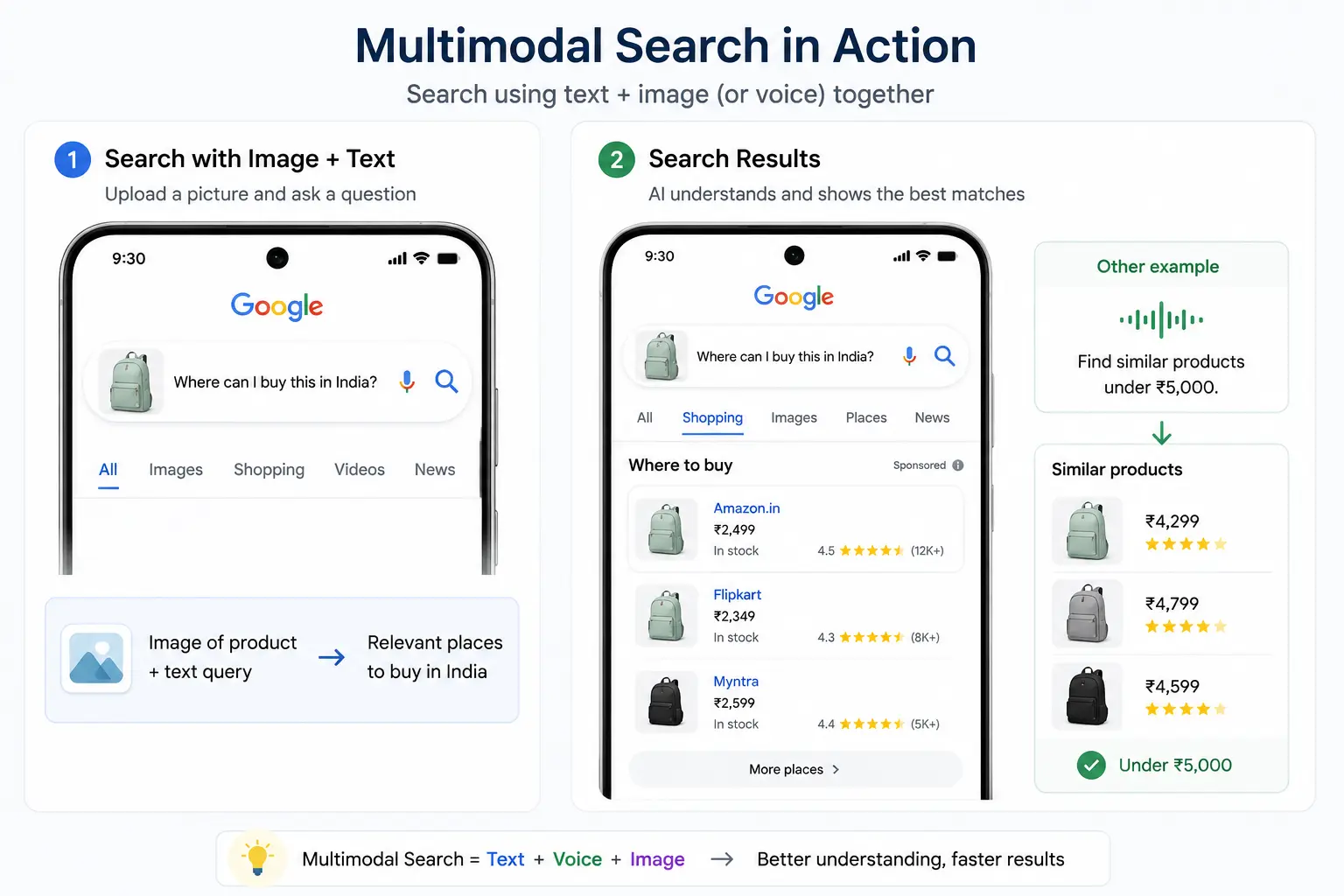
Google now allows users to combine text, voice, and images in a single search.
For example, someone can upload a picture of a product and ask: "Where can I buy this in India?" or "Find similar products under ₹5,000."
4. Longer Search Queries
Instead of typing short keywords, users increasingly ask complete questions.
Old Search: "SEO agency Delhi"
Modern AI Search: "Which SEO agency can improve my local rankings and help generate qualified business leads?"
This shift means businesses must create content that answers real customer questions rather than simply targeting individual keywords.
How Google's AI Search Is Changing SEO
AI-powered Search doesn't eliminate SEO, it changes what successful SEO looks like.
1. Helpful Content Matters More Than Ever
Google prioritizes content that genuinely helps users.
Rather than publishing articles filled with repetitive keywords, businesses should focus on solving problems, answering questions, and providing valuable insights.
Original research, real experience, and practical advice are becoming stronger ranking signals.
2. E-E-A-T Is More Important
Google continues emphasizing:
- Experience
- Expertise
- Authoritativeness
- Trustworthiness
These principles help Google determine whether content deserves to be recommended in Search. Businesses should demonstrate industry knowledge through accurate, transparent, and experience-driven content, as outlined in Google's Helpful Content guidance.
3. Topical Authority Wins
Publishing a single article about SEO is no longer enough.
Instead, businesses should create multiple high-quality articles around related topics. For example:
- Technical SEO
- Local SEO
- AI Search
- Content Marketing
- Google Business Profile
- Website Performance
Together, these articles establish topical authority and improve overall search visibility.
4. Structured Data Becomes Even More Valuable
Google relies on structured data to better understand webpage content and determine eligibility for enhanced search features.
Businesses should consider implementing:
- Organization Schema
- Service Schema
- FAQ Schema
- Article Schema
- Software Application Schema (where applicable)
Proper structured data increases the chances of appearing in rich search experiences.
5. Brand Authority Matters More
As AI Search evaluates trustworthy sources, businesses with strong online reputations are likely to benefit. This includes:
- Consistent branding
- Positive customer reviews
- Quality backlinks
- Expert-written content
- Active digital presence
What Businesses Should Do to Prepare
The evolution of AI Search creates new opportunities for businesses willing to adapt. Here are some practical strategies:
- Create content for people first. Answer real customer questions instead of focusing only on keywords.
- Build topic clusters. Publish multiple related articles that strengthen your authority in your industry.
- Keep content updated. Google values fresh and accurate information, especially for rapidly changing topics.
- Improve website performance. Fast-loading, mobile-friendly websites continue to provide better user experiences.
- Use structured data. Follow Google's official Search documentation to implement structured data correctly and improve content visibility.
- Strengthen your brand. Businesses that invest in trust, expertise, and authority are more likely to be recognized by AI-powered Search.
What Does This Mean for Digital Marketing?
Google's AI Search is reshaping digital marketing strategies. SEO is no longer just about ranking for keywords, it is about becoming the most reliable answer to a user's question.
As AI becomes more integrated into search and customer experiences, many organizations are investing in professional AI Consultation services to understand how technologies like generative AI, automation, and intelligent search can improve their marketing strategies and business operations.
Successful digital marketing in 2026 focuses on:
- Creating helpful, original content
- Building authority within a niche
- Understanding customer intent
- Optimizing for conversational searches
- Producing high-quality videos and visual content
- Strengthening local SEO
- Improving website experience
- Building long-term brand trust
Businesses that embrace these principles are more likely to succeed in Google's AI-driven search environment.
Conclusion
Google's AI-powered Search represents one of the most significant changes in the evolution of search engines. As AI Overviews, AI Mode, and personalized search experiences become increasingly common, businesses must rethink how they create content and connect with their audiences.
The future of SEO is no longer about simply ranking for keywords, it's about delivering valuable, trustworthy, and user-focused information that AI systems can confidently recommend.
At Fenebris India Pvt. Ltd., we help businesses thrive in the AI-driven digital era with expert Digital Marketing Services in Delhi NCR, along with Website Development, AI Consulting, Cloud Solutions, and Staff Augmentation. Whether you're looking to improve your online visibility, optimize your website for AI-powered Search, or build a future-ready digital strategy, our experienced team is committed to helping your business achieve sustainable growth and stay ahead of the competition.
The sooner you adapt to AI Search, the better positioned your business will be for long-term success.
Frequently Asked Questions (FAQs)
1. What is Google AI Search?
Google AI Search enhances traditional search by using artificial intelligence to understand questions, generate summaries, and provide more relevant results with links to trusted sources.
2. What is AI Mode in Google Search?
AI Mode allows users to interact with Google Search conversationally, ask follow-up questions, and receive detailed AI-generated responses.
3. How is AI Search different from traditional Google Search?
Traditional Search primarily lists web pages, while AI Search provides summarized answers, contextual understanding, and conversational interactions before displaying supporting links.
4. Will Google's AI Search affect website traffic?
AI-powered Search may change how users discover websites, but businesses that publish high-quality, trustworthy, and helpful content can continue attracting valuable organic traffic.
5. How can businesses optimize for Google's AI Search?
Businesses should create user-focused content, implement structured data, improve website performance, demonstrate expertise, and build topical authority through comprehensive content strategies.
6. Is personalized Google Search available to everyone?
Personalization features are gradually expanding and depend on user settings, supported regions, and individual Google account preferences.
7. Does Google AI Search use personal information?
Google may use information such as location, search history, or other account data only when users choose to enable personalization features and grant the necessary permissions.
8. Why should businesses update their SEO strategy for AI Search?
As Google's Search experience becomes more AI-driven, businesses that focus on quality content, authority, and user experience are more likely to remain visible and competitive in search results.